
With India's gig economy projected to double in size, reaching over 10 million workers in the coming years, Ola Electric unveiled its new line of budget-friendly e-scooters, starting at under Rs 40,000. The market responded positively, with Ola Electric's stock rising by 5.67 per cent, closing at Rs 73.47 on the BSE.

Two of the three strikes are related to the gig economy, a centrepiece of the new labour Codes.

Cooperation Minister Amit Shah addressed Parliament regarding the challenges faced by Bharat Taxi, a government-backed cooperative ride-hailing platform, including competition from established private aggregators and resistance to digital adoption among drivers.

Calling the decision a win for the people of Karnataka, a Rapido spokesperson said it was not just a legal victory but a milestone moment for urban mobility in the state.

The union alleges financial hardship due to the state government's authorization of panic button device providers.
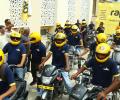
'Today, we have 2 million active drivers earning through our platform every month.'

Finance Minister Nirmala Sitharaman on Saturday said the government will arrange identity cards and registration on the e-Shram portal to assist 1 crore gig workers. Presenting the Union Budget 2025-26, the finance minister also said a scheme for the socio-economic upliftment of urban workers will be implemented.

Fairwork focuses on five principles of fair gig work: Fair pay, fair conditions, fair contracts, fair management, and fair representation.
A group comprising top tech startups and unicorns has raised several "serious concerns" over a platform-based gig workers Bill proposed by the Karnataka government, saying it would hurt the ease of doing business. They told the state government the Bill in its current form would hamper operations and increase regulatory and compliance burden on the nascent gig and startup economy, according to sources.
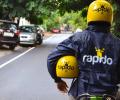
Bike-taxi drivers are also left stranded as many depended on the service.
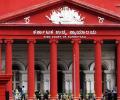
Karnataka transport minister Ramalinga Reddy confirmed the development, stating that the companies must abide by the court's decision.

While mobility aggregators such as Rapido and Uber have welcomed the decision, gig workers associations and unions remain concerned.
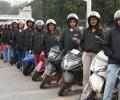
Rising inflation and stagnant wages are forcing a number of salaried professionals to venture into the bike taxi service as part-time riders.

'Nobody wants to run an exploitation factory.'

The two-wheeler giant had only 14 per cent of the electric two-wheeler market in May this year, but its 26.8 per cent in December
If you have seen Zwigato, Param Kumar's story will sound familiar. Laid off from his job as a repairman at a Gurugram-based water purifier provider, he now delivers groceries and food for a mobile-based delivery app, in Delhi. Kumar, who started making deliveries last August, told Business Standard that he is working longer hours than his older salaried job as an RO repairman, and has no paid leaves or health insurance. Kumar is part of India's estimated 7.7 million-strong force of gig workers.
The recent protests by employees of Urban Company and the case of a a Zomato delivery executive who died in a road accident point to the severely straitened condition of gig workers during the ongoing Covid-19 pandemic. Budget 2021 had promised several measures to help the cause of gig economy workers, but most of them are yet to see the light of day. Even after a year, the country's gig workers continue to be without any social security cover or a minimum wage guarantee. "In Budget 2021, finance minister Nirmala Sitharaman had announced that the government is looking toward including migrant and gig workers for social security benefits," says Srinivas Kotni, managing partner, Lexport, a consulting firm. Parliament had passed the Code on Wages in 2019 and Code on Industrial Relations, Social Security and Occupational Safety, Health and Working Conditions in 2020.
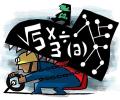
The Code on Social Security, 2020 gives a lot of comfort to gig firms which recognise cab drivers or food delivery executives as 'independent contractors' who directly do business with customers with the help of their digitised platforms.

According to draft Code on Social Security, 2019, gig and platform workers will be entitled to life and disability cover, health and maternity benefits, among others.
Gig workers are usually spoken of in the context of the sharing economy, like Uber, Ola drivers, delivery persons for Zomato and Swiggy and so on. This is the first time such workers will be covered under India's social security law.

Over the past week, several unusual partnerships among start-ups, traditional businesses and hospitals have been announced, and several more are likely to materialise soon. The trend could see increased importance of gig workers, who are taking considerable risk to deliver goods to people in the time of a pandemic.
According to the law, the contribution "should not be more than 5 per cent of the amount paid to gig workers. The government is likely to start seeking contribution from gig companies towards the fund from April 1, 2021.
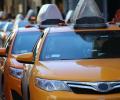
In many states, aggregators operate without a licence; in others, with the risk of the licence being revoked by any regional transport office on the slightest pretext.

Just a few weeks ago, the Centre has come out with the long-awaited Motor Vehicle Aggregator Guidelines, which have drawn a dismayed response from the companies concerned.

'Right to apprenticeship means that anyone below the age of 25 years with a diploma or other qualifications can demand an apprenticeship with a private, a public sector company or a government organisation. And when he/she demands this, it is the obligation of the government to provide it.'
Drawn in by fuzzy promises about unleashing the entrepreneur in each of us and the benefits of being one's own boss, people find themselves instead oppressed by an algorithm, notes Rahul Jacob.

Both companies and individuals seek greater flexibility and freedom.
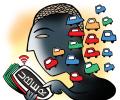
With a report on Uber by the International Consortium of Investigative Journalists (ICIJ) opening a Pandora's box, the company is in a damage-control mode. Distancing itself from the actions of its management pre-2017, Uber, while acknowledging the "mistakes" of the past, has said that under CEO Dara Khosrowshahi, it "is a different company". "There has been no shortage of reporting on Uber's mistakes prior to 2017.
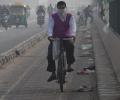
The delivery staff who drop off packages for online retail giants or food or ferry passengers around the city in their taxis are among the worst affected by the capital's foul air.

'Wage earners are shrinking. In both, the organised and unorganised sectors. And, entrepreneurs are growing.' 'But the increase in entrepreneurship is of a kind that does not create salaried employment or daily wage employment,' says Mahesh Vyas.

'Jobs will exist at very high levels or low levels of skill sets.' 'People, who are in middle level jobs, are the ones who are facing the problem as such jobs are fast disappearing because of technological advancement.'

'Google and Facebook need to be tamed, their garb of 'Investing in India's future' need to be pulled off,' observes Vibhu Arya.
 © 2026 Rediff.com - Advertise with us - Disclaimer - Privacy Policy - Sitemap - Feedback - About us - Terms of use - Grievances